
Difference Between Private Limited Company and One Person Company (OPC)
Introduction
Starting a business in India offers many options for registration under the Companies Act, 2013. Among them, the Private Limited Company (Pvt. Ltd.) and the One Person Company (OPC) are two of the most common choices.
Both structures provide limited liability protection, separate legal identity, and corporate recognition, but they differ in ownership, management, and compliance requirements.
Simple Meaning
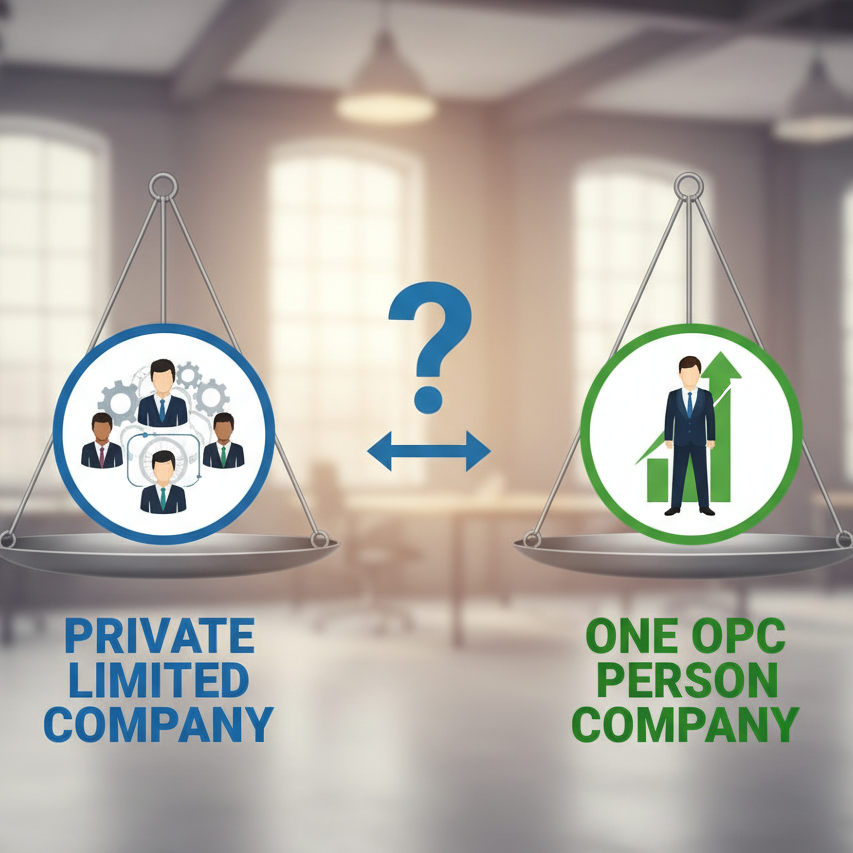
- Private Limited Company:
A company that is owned by a small group of people (minimum 2 and maximum 200 members). It is ideal for businesses that want to expand, attract investors, or include partners. - One Person Company (OPC):
A company that is owned and managed by a single individual. It gives the advantages of a company structure while keeping ownership with one person.
What the Act Says
Both entities are governed under the Companies Act, 2013 and respective rules:
- Private Limited Company:
Defined under Section 2(68) of the Companies Act, 2013.
“A company having a minimum paid-up share capital and which by its articles restricts the right to transfer its shares, limits the number of its members to 200, and prohibits any invitation to the public to subscribe for its shares.”
- One Person Company (OPC):
Defined under Section 2(62) of the Companies Act, 2013.
“A company which has only one person as a member.”
In simple terms, a Private Limited Company involves two or more persons, while an OPC is formed by a single person.
How They Work Differently
| Basis | Private Limited Company | One Person Company |
| Ownership | Owned by at least two members (individuals or companies). | Owned by a single person. |
| Decision Making | Decisions are made jointly by the board of directors and shareholders. | Decisions are taken solely by the owner (member). |
| Nominee | No nominee required. | Nominee appointment is mandatory to take over in case of the member’s death or incapacity. |
| Transfer of Shares | Shares can be transferred to other members or outsiders (restricted by Articles). | Transfer of shares is not allowed except in case of death. |
| Compliance | Higher compliances — board meetings, annual filings, audit, etc. | Comparatively simpler compliances. |
| Expansion | Suitable for startups seeking funding or expansion. | Limited in terms of growth and investment. |
| Conversion | Can be converted into Public Limited Company. | Must convert into Private or Public company if paid-up capital exceeds ₹50 lakh or turnover exceeds ₹2 crore. |
Advantages of Private Limited Company
- Separate Legal Entity: The company exists separately from its owners.
- Limited Liability: Shareholders are responsible only up to their investment.
- Fundraising Opportunities: Easy to attract investors or venture capital.
- Business Credibility: A registered company creates trust among clients and lenders.
- Continuity of Business: The company continues even if directors or shareholders change.
Advantages of One Person Company (OPC)
- Full Control: Single person has total control over the business.
- Limited Liability: Owner’s personal assets are safe from business losses.
- Separate Legal Entity: Treated as a distinct legal person from its owner.
- Ease of Formation: Easy to start and manage.
- Corporate Recognition: Gives a professional image like a company, unlike sole proprietorship.
Demerits of Private Limited Company
- More Compliance: Regular board meetings, audits, and filings are mandatory.
- Restricted Share Transfer: Shares can’t be freely transferred like in a public company.
- Higher Cost: Formation and maintenance cost are comparatively higher.
- Limited Membership: Cannot have more than 200 members.
Demerits of One Person Company (OPC)
- Single Ownership Risk: Entire risk is on one person.
- Conversion Mandatory: Must convert to a Pvt. Ltd. if capital exceeds ₹50 lakh or turnover exceeds ₹2 crore.
- Limited Funding Options: Cannot raise capital from multiple shareholders or investors.
- Limited Growth: Expansion becomes difficult due to single-person ownership.
- Compliance Burden: Although less than Pvt. Ltd., still more than a sole proprietorship.
Easy Example to Understand
Example 1: Private Limited Company
Rohit and Aman start a tech company together named TechGrow Private Limited.
They both are directors and shareholders. If Rohit wants to sell his shares, he can transfer them to Aman or a new member. The company can raise funds from investors, hire employees, and scale up.
Example 2: One Person Company
Meera wants to start her own online clothing business but doesn’t have a partner.
She registers Meera Styles (OPC) Private Limited. She is both the director and shareholder.
Her friend Ritu is the Nominee, who will take over if Meera passes away.
Meera enjoys full control with limited liability.
Detailed Table of Differences
| Particulars | Private Limited Company | One Person Company (OPC) |
| Name Ending | Must end with “Private Limited” | Must end with “(OPC) Private Limited” |
| Minimum Members | 2 | 1 |
| Maximum Members | 200 | 1 |
| Minimum Directors | 2 | 1 |
| Nominee Requirement | Not Required | Mandatory |
| Share Transfer | Allowed but restricted | Not allowed (except on death) |
| Minimum Capital Requirement | No minimum capital required | No minimum capital required |
| Conversion Rules | Can convert to Public Limited | Must convert if capital > ₹50 lakh or turnover > ₹2 crore |
| Fundraising | Can issue shares to investors | Cannot issue shares publicly |
| Ownership | Shared among members | Single person owns entire company |
| Control | Joint control among directors | Single control |
| Continuity | Perpetual succession | Linked to member; nominee takes over |
| Audit Requirement | Mandatory | Mandatory |
| Compliance Burden | High | Moderate |
| Ideal For | Startups, small to medium companies, partnerships | Solo entrepreneurs, freelancers, small business owners |
Conclusion
Both Private Limited Company and One Person Company offer limited liability and corporate status, but the choice depends on the entrepreneur’s goals.
If you plan to work alone with full control, OPC is ideal.
If you want partners, investors, or expansion, then Private Limited Company is better.
In short:
- OPC = One Owner, Easy Management
- Private Limited = Partnership, Better Growth Opportunities
- Difference Between Private Limited Company and One Person Company (OPC)
- Introduction
- Simple Meaning
- What the Act Says
- How They Work Differently
- Advantages of Private Limited Company
- Advantages of One Person Company (OPC)
- Demerits of Private Limited Company
- Demerits of One Person Company (OPC)
- Detailed Table of Differences
- Conclusion